
- Published:
- 22 January 2026
- Author:
- Dr Bernie Croal
- Read time:
- 8 Mins
I hope you all had the chance to take some rest during the holiday season. 2026 is well and truly here – it is going to be a very important and challenging year for pathology and for healthcare across the UK. It will be an equally challenging time for the College as well, but also a great opportunity to highlight the importance of pathology and the potential solutions it can bring to support healthcare.
Following on from our successful parliamentary reception in November, Pathology Solutions, we will build on that positive theme into 2026. It is important, however, that we explicitly advocate the urgent need for investment in pathology services to allow these potential pathology-driven solutions for healthcare to be realised.
Workforce is a vital part of this call. We are already seeing some service failure across the UK, especially those that depend on pathologists and scientists to directly deliver the services. These include paediatric and perinatal pathology and immunology, as illustrated by our recent spotlight publications. Our focus on workforce is now indicating major concerns, backed up by NHS England data, that there are significant gaps emerging in other disciplines. The gap between demand on services and workforce capacity will widen over the next 5–10 years. This is why we have had a strong focus on workforce planning and ensuring we have made key submissions to the 10-Year Workforce Plan in England and to similar consultations in the other UK nations.
Investment in training, automation, digital, AI, interoperability/messaging and the fabric of our facilities is urgently needed. This would be money well spent, given the potential for modern pathology services to unlock wider healthcare pathways. While more collaborative working, minimised duplication and mandatory standardised approaches to the delivery of pathology are important, we believe that this is best achieved by progressing a distributed model of pathology service delivery.
It is essential that our complex services – combining diagnostics with direct clinical care, vital for patients – are protected for the future. Forced consolidation models often cherry-pick the easy work and drive it through a ‘factory model’, paying lip service to the wider importance of the clinical presence and services that we provide. These services are not just critical to patients but also to teaching, training, research and leadership across health services.
Pathology is not a factory service to produce test results. It is an active clinical facing group of disciplines that are embedded within wider healthcare services and support more than just simple diagnostics.
The message for pathology to government, when services are so fragile, needs to be one of urgent investment, not a forced wider consolidation model that brings uncertainty, instability and disruption. It often promises cost savings based on unproven models and siloed financial metrics with little hope of long-term success or realisation. This College will continue to focus on supporting alternative, collaborative, standardised and distributive models of pathology delivery that bring safe patient care, efficiency and cost effectiveness. This must remain professionally backed, sustainable and realistic. This is especially important in the short to medium term, when decision making will be so crucial, given the fragility of our services.
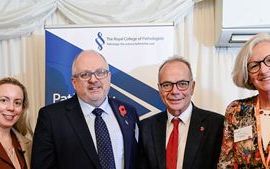
This first edition of the Bulletin in 2026 focuses on the theme of Pathology Solutions. Read about our many events linked to pathology solutions that occurred during National Pathology Week in November 2025. Our parliamentary reception demonstrated how pathology services are pivotal to the successful implementation of the 3 shifts of the NHS 10-Year Health Plan. Articles on how the concept of liquid biopsies could bring solutions that revolutionise cancer screening and diagnosis, how the new patient safety app, My Transfusion, brings real innovation and solutions to transfusion practice, and why our new Workforce Strategy, implemented a year ago, is now returning hugely valuable information and insights that strengthen our advocacy work in this area. Further articles from across our varied disciplines provide interesting insights into the work of our colleagues and the College.
At the end of 2026, we will have significant change to our honorary officer cohort. As many as 6 out of 7 officers will change over, as well as committee chairs, examiners and lay volunteers.
The first election and most important role, just advertised, is that of President of the College. While this is a serious role, with huge responsibility, it is also very rewarding and enjoyable. I would urge anyone who is interested to ensure they are fully appraised of the role/job description, the expectations, the effect on other activities and the likely challenges to be faced in the coming years. It is also vital, given its unpaid, volunteer status, that arrangements are discussed and agreed with employers (and families!) in advance, to ensure that enough time and support is provided to allow the role to be carried out as expected. I am also available to discuss the role, one-to-one, with any prospective candidate.
Further elections will be held for other posts later in the year, including 3 of our Vice-Presidents – again, very important and rewarding roles. While it helps to have previous experience at some level with the College, it is not mandatory. Full training and induction will be given, including ensuring role, job description and expectations are fully understood, with regular appraisal and support provided.
All these roles can be taken up by any of you. What you need to make the role worthwhile is enthusiasm, effort and a will to contribute to College business. These roles work collaboratively with other officers, directors, College staff and our wider membership.
I wish you all the very best of luck…
We are, once again, hosting a meeting focused on the 3 devolved nations, bringing together senior Government, pathology leaders, clinical representatives and College Regional Council members to discuss and focus on pathology-related issues within these countries. This summit will be in February and will be held online. We will ensure we have feedback provided within a future Bulletin later in the year.
2025 was a great first full year for our corporate engagement strategy. Our corporate partners increased in number, with the provision of new webinars, roundtables and meetings being jointly shared and hosted by the College and colleagues from industry. This has been both vitally important as new business but also strengthens our voice and our advocacy work.
Our recent all-day meetings on genomics and our parliamentary Pathology Solutions reception were not only sponsored by industry but also much valued by them. We will continue to work and expand this collaborative effort. It brings huge value to our activities without compromising either our professional independence or our industry partners’ regulatory obligations. We look forward to our Industry Leaders Forum in the College this April to further cement this vital collaborative work.We look forward to the publication of the long-awaited National Cancer Plan by NHS England. This will be very important for pathology and genomics, as it sets out to improve outcomes for cancer patients, speed up diagnosis and treatment, and ensure patients have access to the latest treatments, digital tools and technology. It is another opportunity for pathology to highlight its importance across these vital patient pathways. This was further highlighted by the College’s engagement with the recent consultation on prostate cancer screening, where it was vitally important that the professional viewpoint was considered.
The Long-Term Workforce Plan is due in the spring. While focusing on England, it is clearly also important for the whole of the UK – especially around aspects of training and workforce planning. Meanwhile, the College continues to actively engage with the commissioned Carter Review. Having attended several partner board meetings, we need to continue constructive discussion to ensure all voices are heard and that any output has the best chance of being both supported and implemented by the stakeholders at large. I would expect this to be completed and published by spring/early summer.
We have recently revamped our much-valued and sought after RCPath Achievement Awards, bringing in some corporate sponsorship and focusing on celebrating teams in pathology for innovation and excellence. We have just opened applications for our 2026 awards and will celebrate the winners at our Annual Dinner in June.
Colleges have had a difficult few years, by and large. There is a stronger willingness to challenge the value of colleges. Some issues have been contentious, with members having diverse views. Our colleges remain vitally important for patients, wider healthcare and for the professional wellbeing of our members.
The volunteer model is increasingly challenging, especially as it has become increasingly difficult for our members to be released to do College work – but we have been rallying against this and have managed to see some plans that inhibit volunteering being reversed or watered down.
We have, both individually and collectively, via the Academy of Medical Royal Colleges, been strongly advocating and reminding government and hospital management of all the important work that colleges do around training, examinations, standards, advisory work, public/patient engagement and many other areas. We have made the case that we do all this unfunded and with huge reliance on a supportive volunteer model, and that any attempts to diminish or make these processes more difficult will cost them more than they will gain.
Members also often ask me what they get for their subscription fee. While the College does provide many benefits, it is the work that we do for the profession that is most important – especially at the current time when our professional and patient wellbeing is at huge risk. We need a strong College, supported by members. I urge all of you to continue as members and consider volunteering, at whatever level you can, to do vital College work or to take on one of our many positions across our committees, directorships, examiner panels and officer roles. Our professions, healthcare and patients need a strong College, and a strong College can only be provided by its members continuing to value and support its work.
Meet the author
-

Dr Bernie Croal
President, Royal College of Pathologists
Read next
Introducing our theme: Pathology solutions
22 January 2026


Celebrating International Pathology Day 2025
22 January 2026