
From shaping standards and guidance, to supporting education and assessment, to participating in committees and working groups, our volunteers play a vital role in strengthening the pathology profession and helping the College deliver for its members and the wider public.
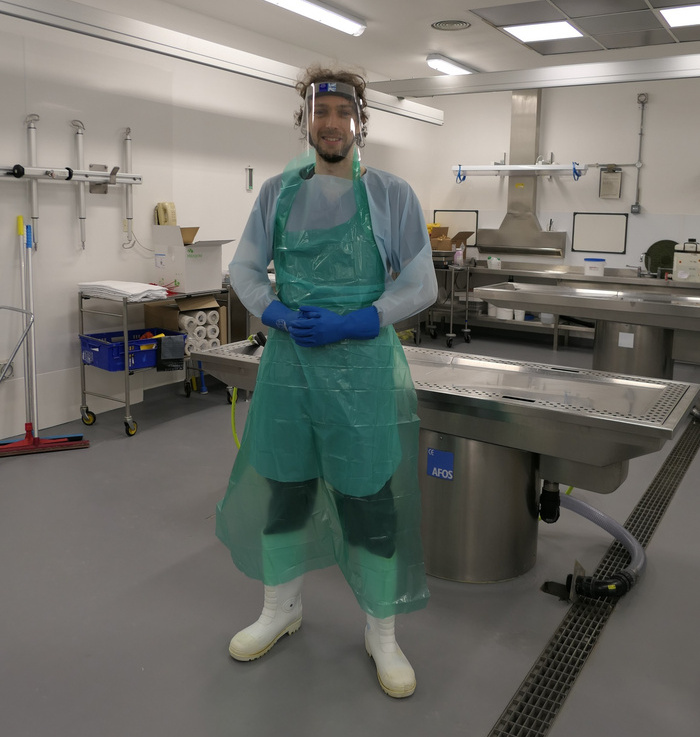
Today’s spotlight member is Dr Adam Douglas, a Consultant Histopathologist who has worked extensively with the College to produce the first autopsy guideline on diving deaths. Dr Douglas was nominated for this volunteer spotlight by Reece Carfrae, Senior Professional Guidelines Officer at the College. Reece said:
“Dr Adam Douglas has worked extensively to produce a new autopsy guideline for the College, engaging with multiple stakeholders to ensure a comprehensive guide to support pathologists in diving related autopsy. He has been exemplary throughout the process and a pleasure to work with.”
This guideline is due for publication by the end of June 2026. In the meantime, you can find all other College guidance on our website.
Can you tell us a bit about your background? What drew you to pathology (and specifically histopathology) as a profession?
My earliest aspiration was to become an inventor, although as I approached adulthood the lack of a defined career path stymied that somewhat. My pathology career bloomed from an encounter with Kathleen Mulholland, a pathologist in Altnagelvin Hospital in Londonderry, whose enthusiasm for the specialty managed to outweigh my inability to interpret histology as a medical student. Alongside the lab experience I gained during my intercalated Master's degree, this was enough to convince me that histopathology was the right choice for me. Being able to solve problems in a non-chaotic environment was the perfect combination, and I took the first opportunity to apply for training. I had limited exposure to post mortems during medical school, although we did extensive cadaveric dissection in Queen’s University Belfast.
I started my pathology training journey in Cardiff which included an excellent month-long autopsy attachment in the Royal Glamorgan Hospital and Prince Charles Hospital with Dr Esther Youd and Dr Jason Shannon. This was the foundation I built upon when I moved down to the Southwest and settled into Plymouth, and got the chance to work with a fantastically supportive and enthusiastic team. I got into diving death investigation a little later.
You're currently a guideline author at RCPath. Can you tell us more about how you got involved and what this role entails?
My route into guideline authorship was a little circuitous. I had experience with scientific writing but not with guidelines or protocols, except in a very superficial capacity. I had attended an interesting inquest with Paul Malcolm, now retired, who was a specialist in recreational diving death investigation. I found it fascinating but complex, and without a background in diving I didn’t think I would end up involved. However, one day in the corridor he asked if I’d like to take over from him, and thus began my interest in diving death.
One of my colleagues, Dr Katherine Syred, is on the RCPath Death Investigation Committee and is the Lead Examiner for the Certificate in Higher Autopsy Training (CHAT) exam. She proposed the idea for an autopsy guideline looking at recreational diving death, as this is a complex area and one that is not always handled well. The guideline was aimed at improving the quality and consistency of post-mortem investigation of diving deaths. I'd like to thank Katherine for all her support.
The guideline author role involves exploring and evaluating the relevant literature and summarising this alongside a practical approach to real world cases.
How will this guideline benefit members and the wider profession?
The hope is that this autopsy guideline will provide a structured way to approach recreational diving death investigation for autopsy pathologists, with the aim of improving quality and consistency of these post mortems. Hopefully this will offer a chance to learn from these rare incidents and make recreational diving a safer sport.
What do you enjoy about this work, and how has it benefited your professional development or practice?
There has been a considerable amount of work involved in drafting the guideline. Having the chance to read more around the subject matter and formulate it into an accessible format has been challenging, but seeing it come together, with the assistance of Dr Ben Swift and Dr Esther Youd, has been rewarding. The process is a major collaborative effort with input from a number of interested parties – sorting through the comments and feedback offers an additional challenge while trying not to take it personally!
I'd like to say a big thank you to Reece Carfrae and the guidelines team for keeping me sane through the process, as well as a thank you to my excellent colleagues in the Histopathology department and the Mortuary who have been supportive along the way while I developed my niche.
What have been the positives of volunteering with the College, and what advice would you give to other members interested in getting involved?
The Guidelines team have been really supportive and patient during the rocky start (the process has taken a couple of years due to various unexpected challenges), and the Publishing team have been helpful in getting the guideline into its final form. To anyone interested in volunteering, I would say go for it! It’s a great chance to develop new professional skills and network with equally enthusiastic people.
What are your hopes for the future of pathology in this particular field?
Within autopsy pathology, we struggle to get enough trainees to continue post-mortem training beyond the CHAT exam. We are hoping to support and develop autopsy training within our department to address this.
Imaging-based post-mortem examinations, and post-mortem computed tomography (PM-CT) in particular, are becoming more prevalent. Having access to this can only benefit diving death investigation through more accurate tissue/blood gas interpretation.
The post-mortem examination is one component of the process in diving death investigation, but my hope is that more of these fatalities will be investigated in a collaborative manner with diving medicine physicians and other experts facilitating learning and hopefully preventing further incidents.
Our thanks to Dr Douglas for his work on this guideline, and for such a fascinating interview. If you’d like to get involved in the College’s work producing guidance for pathology, please contact the Professional Guidelines team.
We will be continuing our volunteer spotlights throughout the week, so keep an eye out for the next blogs. We hope these stories inspire you to explore the many ways you can get involved with our activities and help champion pathology.
If you have any questions on our member spotlights, or have an idea for a blog you’d like to write, please get in touch with the Member Engagement and Support team.
Author(s)
