
- Published:
- 20 July 2026
- Author:
- Hayley G Evans, Mike F Murphy, Robbie Foy, Paula Dhiman, Alwyn Kotze, Antony J Palmer, Louise Strickland, Susan E Robinson, Sam Warnakulasuriya, Simon Stanworth
- Read time:
- 9 Mins
Many sick, hospitalised patients, at all ages, receive blood transfusions, often repeated. But are all these transfusions needed, and do we have sufficient understanding of the balance between benefits and risks?
The Infected Blood Inquiry report highlighted systemic failure to recognise harm and to engage with patients.1 Although this report focused on the context of haemophilia, there were multiple recommendations that are relevant to the wider blood transfusion community. Transfusion practice also needs to respond to ongoing haemovigilance messaging from the Serious Hazards of Transfusion (SHOT) programme, which continues to demonstrate avoidable harm and system vulnerabilities in transfusion practice.2 Indeed, it has been said that blood for transfusion might be better considered a form of cellular transplantation.
A key challenge for transfusion services across the UK is to ensure pathways are in place to evaluate the outcomes of each transfusion, whether beneficial or harmful.1 This leads on to a series of questions.
- Do we know which patients receive blood?
- Do we have data to tell us whether patients are receiving blood or alternatives to transfusion appropriately, in a way that is consistent with national standards and patient blood management principles?3
- Which patients benefit from receiving a blood transfusion, given the substantial evidence base from randomised trials informing transfusion thresholds?4 Should national standards be updated in line with evolving evidence?
- What are we doing to ensure that blood is given appropriately?
- What is being done to implement the recommendations of the Infected Blood Inquiry?
Unfortunately, there remain substantial gaps in our ability to answer these questions. Our knowledge of fundamental ‘real-world’ transfusion practice remains limited. We also know transfusion practice across the NHS is highly variable and, in many settings, difficult to measure with sufficient precision.5,6 Addressing these gaps requires systematic use of routinely collected data at scale.
The National Institute for Health and Care Research (NIHR) Blood and Transplant Research Unit in Data-Driven Transfusion Practice (BTRU-DD) was established to meet this need and speed up use of health data science for transfusion medicine, to support research, benchmarking and quality improvement. A more data-enabled transfusion system can identify and address unwarranted variation, engage the wider clinical community and provide an evidence base to drive sustained improvement.
4 broad themes, or work packages, were developed as part of the BTRU-DD programme, covering indicators, implementation, databases and health economics. Work to date has identified key system level challenges that limit our ability to answer the questions outlined above. Firstly, the data required to monitor practice effectively and target research remain fragmented across laboratory systems, hospital records and organisational boundaries. Secondly, audit processes remain largely manual, retrospective and limited in scale, restricting the ability to generate timely insights or track performance consistently over time.7
A major element of the BTRU-DD programme is the NIHR Patient Blood Management and Perioperative Care Health Informatics Collaborative (PBMPC HIC) database (Figures 1 and 2). This is the first multi-site, transfusion-specific data repository established under NIHR HIC governance in England. By linking transfusion laboratory data with electronic patient records within a secure data environment, the PBMPC HIC provides a platform for real-world evaluation of transfusion practice and outcomes. It already includes more than 2 million patients and over 500,000 transfusion events across participating NHS Trusts.
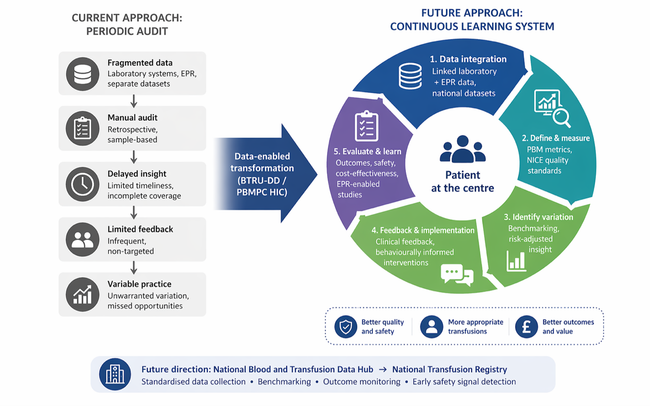
Figure 1. From periodic audit to a continuous learning system in transfusion practice. Current monitoring relies on fragmented data and retrospective audit, limiting timely insight. The BTRU-DD, supported by PBMPC HIC, enables a transition to a continuous learning system, in which routinely collected data supports benchmarking, identification of variation, targeted feedback and evaluation, underpinning ongoing improvement and future development of a national Data Hub and Transfusion Registry. BTRU-DD, Blood and Transplant Research Unit in Data-Driven Transfusion Practice; EPR, electronic patient records; NICE, National Institute for Health and Care Excellence; PBM, patient blood managemen; PBMPC HIC, Patient Blood Management and Perioperative Care Health Informatics Collaborative.
The database will provide a key future resource for new research and audit efforts. It allows us to develop and apply electronic indicators aligned with NICE quality standards for blood transfusion and other national guidance, to explore variation in practice, and to provide structured feedback to hospitals and clinicians.8 In addition, the shared BTRU database creates the potential to generate UK-specific synthetic health data (datasets that replicate the statistical properties and relationships of real data, without replicating individual patient data). Carefully validated synthetic datasets could enable wider access for method development, training, international collaboration and early-phase evaluation, while protecting patient confidentiality.
As an example, early analyses have highlighted important differences in areas such as tranexamic acid use in surgery, despite a strong evidence base and clear guidance.9,10 These findings illustrate a central principle of the BTRU-DD: data is most valuable when it leads to practical change.Therefore, implementation science is embedded within the BTRU, alongside analytics and health economic evaluation, to better understand not only what varies, but how best to improve it.7,11 These approaches also create a foundation for embedding pragmatic evaluation within clinical systems, including electionic-patient-record-enabled trials and more targeted, behaviourally informed feedback to clinicians.
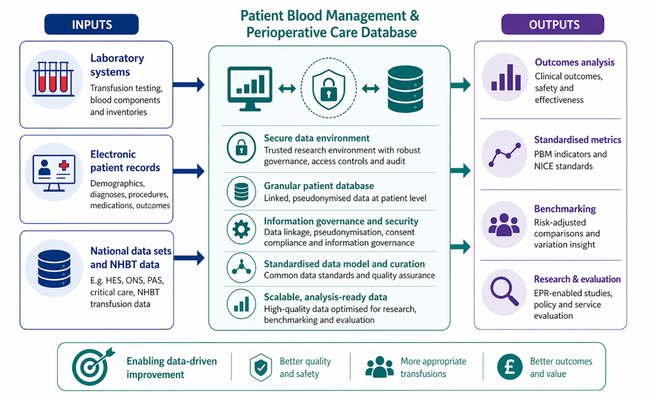
Figure 2. PBMPC HIC: linking transfusion data to clinical outcomes. The PBMPC HIC integrates transfusion laboratory data, electronic patient records, and national datasets within a secure data environment, enabling large-scale analysis of transfusion practice and outcomes. This supports the development of standardised metrics, benchmarking and evaluation, providing a foundation for data-driven research and quality improvement.
The NICE Quality Standards for Blood Transfusion form a core element of national standards, but typical manual-based audits have limitations. Here the BTRU-DD looked to methods to harness electronic data collection, using the exemplary case of tranexamic acid in surgery. This work will enable the development of automated indicators, scalable analytics and more consistent feedback to clinical teams.
One vision is to extend data linkage work into a national Blood and Transfusion Data Hub and ultimately a National Transfusion Registry, building on existing infrastructure and routine data flows. Such a system might provide a secure, federated framework for standardised data collection, linkage and reporting. It would support ongoing benchmarking, outcome monitoring and earlier detection of safety concerns, while reducing the burden of manual audit. Importantly, it would also align transfusion data infrastructure with the NHS’s wider data environment, creating opportunities for further linkage and interoperability ensuring that transfusion practice is embedded within the wider digital architecture of the NHS.
In this sense, the BTRU, PBMPC HIC and future registry work are all part of the same journey: towards a more integrated, transparent, and learning-based approach to transfusion medicine, with the patient firmly at the centre. No one doubts that the NHS is overburdened, which constrains our ability to optimise practice and to implement data-informed approaches that could deliver efficiency savings. Ultimately, we wish to move beyond periodic manual audit towards a more continuous learning model,12 in which routinely collected clinical data is used to inform practice, support timely interventions and reduce unwarranted variation and waste.13
Importantly, these approaches also open up new opportunities for evaluation and research. The integration of data within clinical systems creates the potential for more pragmatic, EPR-enabled research studies, alongside more targeted and behaviourally informed feedback strategies that are better aligned with the realities of clinical decision making.
Taken together, these developments support a transition towards a more integrated and transparent approach to transfusion practice, where data are not only collected, but actively used to improve patient care. In this context, the longer-term development of a national Data Hub and Transfusion Registry represents not an endpoint, but a necessary step in establishing a sustainable, system-wide infrastructure capable of continuously evaluating, improving and safeguarding transfusion practice for patients.
References available on our website.
Meet the authors
-

Dr Hayley Evans
Deputy Director, NIHR Blood and Transplant Research Unit in Data-Driven Transfusion Practice, University of Oxford
-

Professor Mike Murphy
Professor of Transfusion Medicine, NIHR Blood and Transplant Research Unit in Data-Driven Transfusion Practice, University of Oxford
-
Robbie Foy
Clinical Professor of Primary Care, Leeds Institute of Health Sciences, University of Leeds
-
Paula Dhiman
Associate Professor, Centre for Statistics in Medicine, Botnar Research Centre
-
Alwyn Kotze
Consultant in Anaesthetics, Leeds Teaching Hospitals
-
Antony J Palmer
Consultant Orthopaedic Surgeon, Nuffield Orthopaedic Centre, Oxford University NHS Foundation Trust
-
Louise Strickland
Nursing and Midwifery Research and Innovation and Honorary Departmental Clinical Academic Nurse Researcher, Oxford University Hospitals NHS Foundation Trust
-
Susan E Robinson
Consultant, Guy's and St Thomas' NHS Foundation Trust
-
Sam Warnakulasuriya
Consultant in Anaesthesia and Perioperative Medicine, University College London Hospitals NHS Foundation Trust
-

Professor Simon Stanworth
Professor of Haematology and Transfusion Medicine, NIHR Blood and Transplant Research Unit in Data-Driven Transfusion Practice, University of Oxford