
- Published:
- 20 July 2026
- Author:
- Victoria Tuckley, Dr Jennifer Davies and Dr Shruthi Narayan
- Read time:
- 8 Mins
This article outlines what makes transfusion practice in transplant patients distinct, drawing on analysis of reports submitted to the Serious Hazards of Transfusion (SHOT) UK haemovigilance scheme. It highlights the common risks and describes practical, system‑level improvements to enhance transfusion safety throughout the transplant pathway.
Blood transfusion is a critical component of care for patients undergoing haemopoietic stem cell transplantation (HSCT) and solid organ transplantation (SOT), but it carries unique risks and complexities. ABO incompatibility, special component needs and shared care across multiple organisations all increase the potential for error.
Transfusion support for transplant patients often presents more complexity than in non-transplant patients for many reasons, discussed in detail for each patient group below.
Transfusion in HSCT
In allogeneic HSCT, it may not always be possible to ABO match the donor and recipient (Table 1). Approximately 40–50% of HSCTs are ABO incompatible.1 Major incompatibility occurs where antibodies in the recipient’s plasma can react with donor red cells (e.g. recipient group O and donor group A) and minor incompatibility occurs where antibodies in the donor plasma can react with recipient red cells (e.g. recipient group A, donor group O). Bidirectional incompatibility involves major and minor mismatches (e.g. recipient group B and donor group A). Major and minor incompatibility each occur in approximately 20–25% of HSCTs, and bidirectional incompatibility in 5%.1
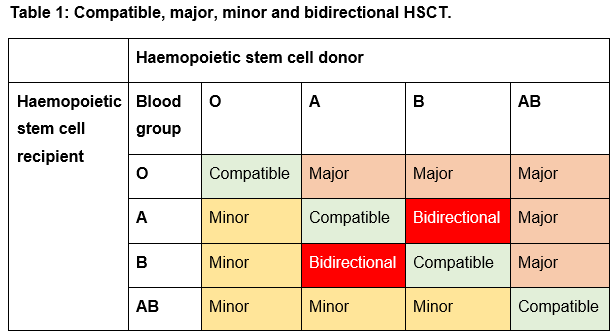
Decisions on suitable ABO and D group of blood components must consider mismatches and the transition period until the stem cells have engrafted and the patient converts fully to their new group. This poses challenges for blood selection, as blood must be compatible between donor and recipients until complete engraftment is confirmed (Table 2).2
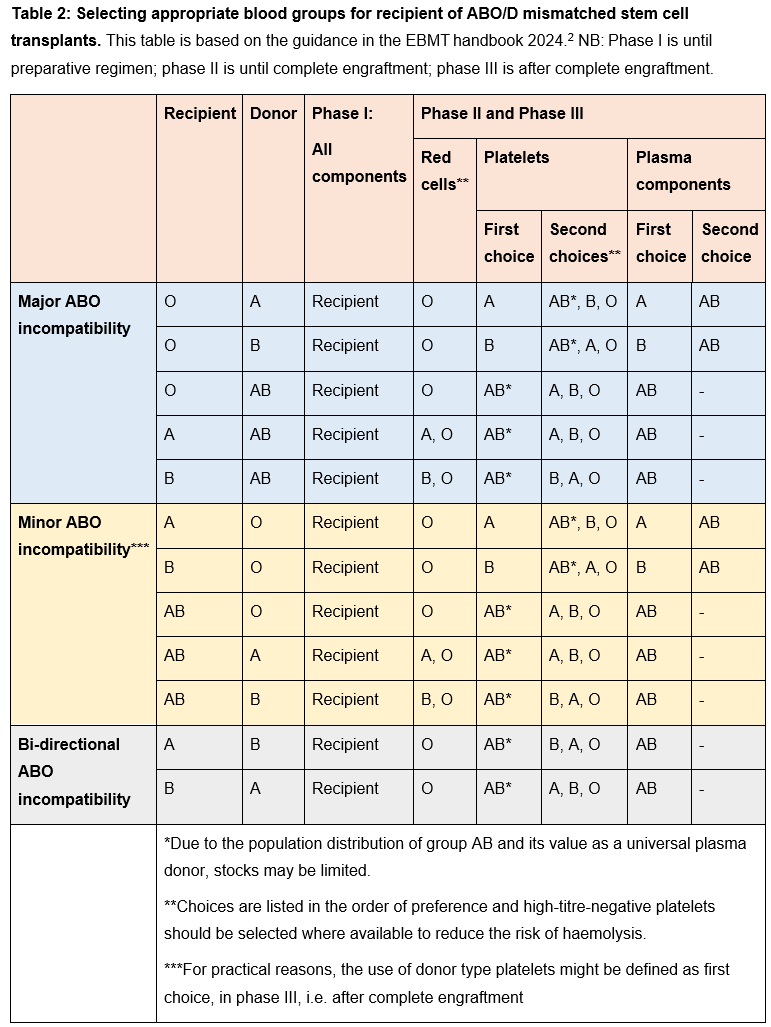
Due to transfusion of non-ABO identical blood components, interpretation of blood group results for HSCT patients may be difficult, since dual populations of patient and donor cells may be seen in the forward group and unexpected reaction or loss of reaction may be seen in the reverse group. Furthermore, HSCT patients will require irradiated cellular blood components prior to and following transplant to reduce the risk of transfusion-associated graft-versus-host disease. Timings differ, depending on whether the patient has received an autologous or allogeneic transplant, and are also influenced by donor cell engraftment and the use of immunosuppressants.3 Recipients of incompatible HSCT also require serological crossmatch.4
Transfusion in SOT
For patients undergoing SOT, red cells need to be compatible with donor and recipient to reduce the risk of passenger lymphocyte syndrome. Recipients may require plasma exchange pre-transplant to reduce the titre of anti-A or anti-B in their circulating plasma. Where a recipient of childbearing potential is D-negative, and they have received a D-positive organ, they may require anti-D immunoglobulin (Ig) prophylaxis following estimation of volume of circulating red cells 24 hours post-transplant.
Furthermore, patients who have received SOT should be excluded from electronic issue and require serological crossmatching for 3 months post-transplant to enable the detection of IgG isoagglutinins produced by passenger lymphocytes.4
Transfusion errors in transplant patients reported to SHOT have increased in recent years (Figure 1). These mostly involve failure to provide irradiated blood components, or transfusion of ABO/D-mismatched red cells.
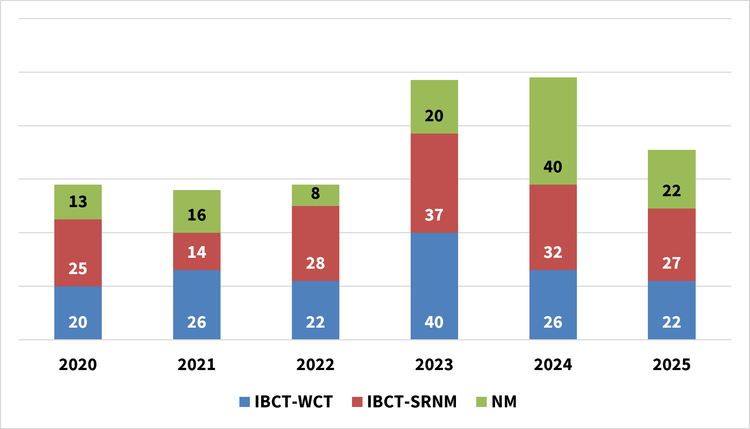
Figure 1: Transfusion errors in SOT and HSCT patients reported to SHOT 2020–2025 (n=438). HSCT, haemopoietic stem cell transplantation; IBCT-SRNM, incorrect blood component transfused - specific requirements not met; IBCT-WCT, incorrect blood component transfused - wrong component transfused; NM, near miss; SHOT, Serious Hazards of Transfusion; SOT, solid organ transplantation.
Laboratory errors are often influenced by the laboratory information management system (LIMS). This includes failure to update the LIMS with the specific requirement, failure to heed warning flags, or lack of functionality to support the complex requirements of transplant patients.
Shared care introduces communication challenges. Transplant protocols may not be sent between hospitals, or there may be delays updating clinical notes and the LIMS. Addressing communication issues with patients in shared-care settings is crucial for ensuring safe, coordinated and patient-centred care. Communication failure between hospitals sharing the care of transplant patients is a recurring theme within haemovigilance data.
The cases below illustrate how transfusion has adversely impacted care in transplant patients.
Case 1: Patient transfused with non-irradiated red cells pre-transplant with shared-care barriers
A patient with relapsed lymphoma received a unit of non-irradiated red cells at their local hospital, 6 days prior to stem cell harvest. The request did not indicate the patient’s diagnosis, or the need for irradiated red cells, which was also not recorded on the prescription. There was also incomplete communication from the transplant centre to the local hospital.
Contributory factors included handwritten documentation being used instead of the electronic patient record. A system has since been set up for the transplant centre to notify the local transfusion laboratory, the transfusion practitioner and clinical staff about specific requirements using secure email. The patient was given an irradiated components card and relevant information leaflet, and had the rationale for the specific requirement explained to them.
Case 2: Renal transplant delayed due to issue of incorrect ABO group plasma
A patient was due to have an ABO-incompatible-directed kidney transplant following a course of plasma exchange to remove circulating anti-B antibodies. They were prescribed 4 units of group AB fresh frozen plasma (FFP) but were issued group O in error. Although compatible with the patient, this increased the anti-B titre beyond acceptable limits and the transplant was aborted after donor surgery had already begun. The transplant was re-scheduled a week later.
Gaps in communication between clinical and laboratory teams contributed to this event. A comment within the LIMS notes about the component ABO requirements was also not prominent. The biomedical scientist issuing the FFP was working alone supporting a patient with a massive haemorrhage and was fatigued following multiple consecutive night shifts.
Clear, timely communication is essential for transfusion safety in the transplant setting. Clinical teams, transfusion laboratories and transplant centres need effective, standardised mechanisms to ensure the correct information is recorded and transferred across sites and to all involved in the care of the patient. This should include:
- the transplant timetable
- the need for specific transfusion requirements
- ABO/D groups of the transplant recipient and donor
- the potential need for anti-D prophylaxis in SOT.
Processes in the laboratory to record information provided by clinical communications should take place in a timely manner. This includes setting appropriate LIMS flags and informing the clinical area that the information has been received and acted upon. It may also be appropriate for a relevant member of laboratory staff to attend multidisciplinary team meetings at transplant centres, to facilitate effective communication between these teams. LIMS should contain algorithms to support appropriate component ABO/D compatibility and specific requirements. Any LIMS alert overrides should include a requirement for justification that can be audited.
Furthermore, it is vital to include patients in all decision-making. Discussions should include information about their specific transfusion requirements. Tools such as SHOT’s free My Transfusion patient information app (featured in the January 2026 Bulletin) can aid in consent and shared decision-making conversations.
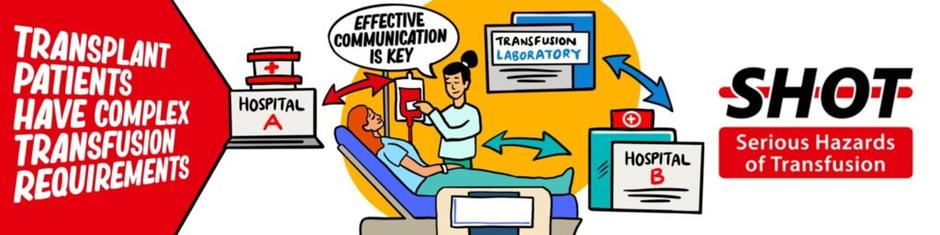
Transfusions form one part of a complex and lengthy care pathway for this patient group. It is essential that transfusions are delivered in a considered manner, backed up by sufficient knowledge and up-to-date systems, with accountability, to ensure safe care is being provided to patients facing a difficult and often daunting treatment journey.
SHOT data shows that many transfusion errors in transplant patients are preventable and often arise from communication failures, system limitations and lack of visibility of transplant‑specific requirements. By translating haemovigilance insights into system improvements, more reliable transfusion care can be delivered throughout the transplant journey.
For more information, please visit www.shotuk.org or contact the SHOT team via email [email protected].
References available on our website.
Meet the authors
-

Victoria Tuckley
SHOT Laboratory Incident Specialist, Serious Hazards of Transfusion
-

Dr Jennifer Davies
Transfusion Laboratory Manager, Royal Devon University Healthcare NHS Foundation Trust; Deputy Chair of the UK Transfusion Laboratory Collaborative; SHOT Working Expert Group member
-

Dr Shruthi Narayan
Medical Director, SHOT
Read next


Xenotransplantation – are we there yet?
20 July 2026